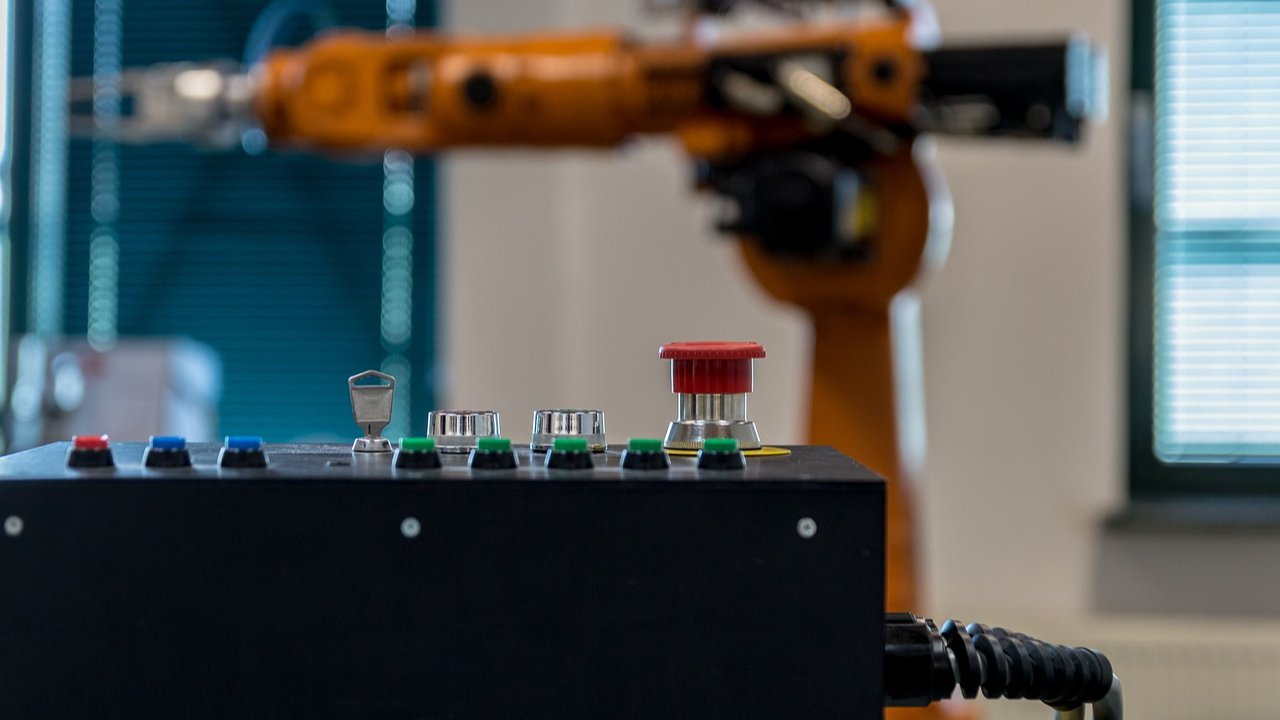
On the production floor of Indonesian factories, one sight is still too often encountered: operators standing next to machines, pressing manual buttons, recording numbers on a whiteboard. Processes that should run automatically still rely on human reactions. In fact, a single delayed response can mean product rejection, or even workplace accidents.
Data from the Ministry of Industry shows that the utilization of national manufacturing capacity remains around 70-75% throughout 2024. This figure could actually be higher if not for downtime largely triggered by manual processes and human error. Automation is no longer a matter of futuristic ambition. It is about basic efficiency that should already be a standard.
PLC: The Small Brain that Drives the Production Line
Programmable Logic Controller, or PLC, is an industrial computer specifically designed to control mechanical processes. Its function is simple yet crucial: receiving input from sensors, processing logic, and then sending commands to actuators. Conveyors run, valves open, motors spin, all because the PLC reads conditions and reacts in milliseconds.
What often goes unnoticed: PLC is not a new technology. It was first introduced in the late 1960s by General Motors to replace relay panels. Yet even today, many small and medium industry players in Indonesia are still unfamiliar with how it works. They know the term, but do not understand how to program ladder diagrams or configure input/output correctly. As a result, expensive machines are only operated at half capacity.
HMI: The Bridge Between Machines and Humans
If the PLC is the brain, then the Human-Machine Interface (HMI) is its face. The touchscreen displays machine status, real-time production graphs, and alarms when parameters go out of bounds, all handled by the HMI. Operators do not need to open electrical panels or read error codes from indicator lights. Just look at the screen, and the situation is immediately clear.
A poorly designed HMI can be just as dangerous as having no HMI at all. A cluttered display, confusing navigation, or alarms that sound too frequently can lead operators to ignore them. This is not a hypothetical scenario. Reports from the International Society of Automation (ISA) indicate that alarm overload is one of the main causes of incidents in industrial plants globally. A well-designed HMI must be intuitive: important information should be front and center, navigation logical, and alarms truly meaningful.
Time Chart and Sequential Logic: Foundations Often Overlooked
Before writing a single line of PLC program, there is one step often skipped, especially by self-taught technicians: creating a time chart. A time chart is a time diagram that illustrates the sequence of operations, when motor A turns on, when sensor B activates, how long the delay is before process C starts. Without this, programmers tend to jump straight into coding and fix bugs on the fly. This trial and error is costly, both in terms of time and machine damage.
Sequential logic also determines how the system responds to abnormal conditions. What happens if the sensor fails to read? How does the system revert to a safe condition? These questions must be answered at the design stage, not after the machine is installed in the field.
Automation is Not About Replacement, But Elevation
The fear that automation will eliminate jobs remains a dominant narrative, especially in labor-intensive manufacturing sectors. But the reality is more nuanced. The McKinsey Global Institute, in its report on automation in ASEAN, notes that automation shifts job types more than it eliminates them. Operators who once pressed manual buttons transition to technicians monitoring systems, analyzing production data, and troubleshooting. Their salaries increase, and risks decrease.
For Indonesia, which is pushing for industrial downstreaming, mastering basic automation such as PLC and HMI is no longer optional. It is the minimum competency that industrial workers must possess to compete in the global supply chain. The question is no longer whether to learn, but how far along you are.
References:
- Ministry of Industry of the Republic of Indonesia – Manufacturing Industry Performance Report 2024 → kemenperin.go.id
- International Society of Automation (ISA) – Alarm Management Standards: ISA-18.2 → isa.org
- McKinsey Global Institute – The Future of Work in ASEAN → mckinsey.com