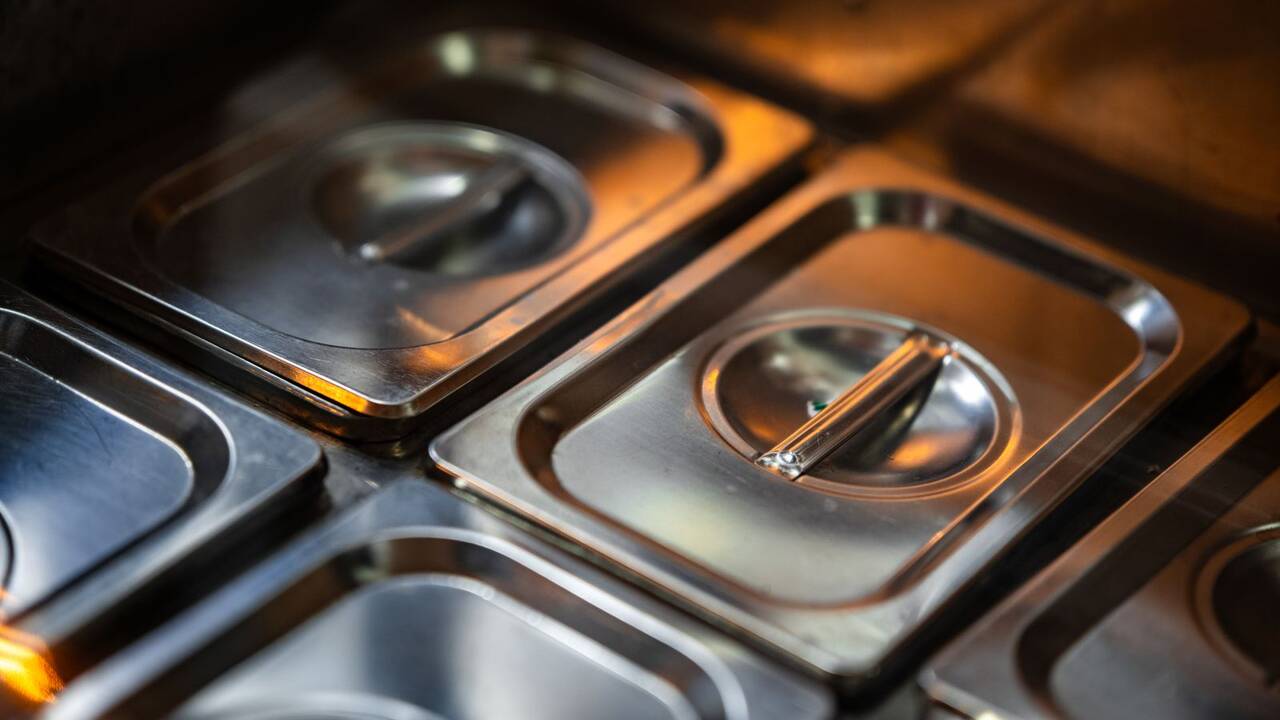
The production kitchen is always hotter than the dining area. The frying pans are on fire throughout the busy hours, and the exhaust fans never truly catch up. The first reflex of many kitchen managers is to chase the room temperature. Food safety regulations in Indonesia do not require that.
Hot kitchens are always in the danger zone
The Food and Drug Monitoring Agency (BPOM) defines the range of 5 to 60 degrees Celsius as the Food Temperature Zone or danger zone. Within this range, pathogenic bacteria grow the fastest, and under suitable conditions, their numbers can double in about 20 minutes. The Pocket Book of Risk-Based Food Hygiene Sanitation Monitoring published by the Ministry of Health uses the same range.
The consequences are straightforward. A hot kitchen is within that zone throughout operational hours, and no fan can pull it out. Since room temperature is not a variable you can lock in, the only option left is to control how long food stays there.
The clock runs faster when the room is hotter
The attachment to Minister of Health Regulation Number 2 of 2023 stipulates that perishable cooked food stored at room temperature must be consumed within 4 hours after cooking. Beyond that limit, the food must be reheated before it can be served. The Ministry of Health's pocket book refers to the same limit as the 4 hour rule, with a minimum reheating temperature of 75 degrees Celsius.
That is not the only clock that runs. BPOM advises a stricter limit: food left at room temperature for more than two hours is at risk of no longer being safe, and that limit drops to one hour when the ambient temperature exceeds 32 degrees Celsius. The two do not negate each other. The first is a compliance limit for cooked food, while the second is a preventive recommendation that is most relevant in high-temperature kitchens.
The hotter the room, the shorter the safety window. The gap between when raw materials are finished being cut or washed and when they enter the frying pan should be measured in minutes, not left to flow until it’s time to cook.
Numbers worth posting on the kitchen wall
The attachment to Minister of Health Regulation Number 2 of 2023 contains limits that can be directly used as work parameters:
- Hot cooked food served: 60 degrees Celsius or more in warming facilities.
- Ready-to-eat processed food with broth: kept hot above 60 degrees Celsius.
- Cut fruit, salads, and similar items: below 5 degrees Celsius.
- Cooked food that needs cooling during transport: 4 degrees Celsius or less.
- Frozen cooked food during transport: minus 18 degrees Celsius or below.
- Cold dishes at temperatures below 10 degrees Celsius: maximum 2 hours outside refrigeration.
- Transfer between transport equipment and storage facilities without temperature control methods: less than 20 minutes.
- Catering sample bank: 1 portion for each menu, stored in the refrigerator for 2 x 24 hours.
The Ministry of Health categorizes cooked food that is stored at dangerous zone temperatures and consumed more than 4 hours after cooking as high-risk, with a score of 15, the highest score in their food hazard assessment.
The legal basis has changed twice
Many kitchen procedures in the field still refer to Minister of Health Regulation Number 1096 of 2011 concerning Hygiene and Sanitation Guidelines for Catering Services. This regulation has been revoked by Minister of Health Regulation Number 2 of 2023, along with the Minister of Health Decree Number 1098 of 2003 concerning restaurants and eateries and the Minister of Health Decree Number 942 of 2003 concerning street food.
The next layer is even newer. Minister of Health Regulation Number 3 of 2026 concerning Disease Control, effective from March 11, 2026, partially revokes Minister of Health Regulation Number 2 of 2023, with exceptions for Articles 12, 21, 23, 29, 32, 39, and 45 along with the Attachments. All technical standards above are indeed located in the Attachments, so they remain in effect. What needs to be updated is the references in procedural documents.
What has changed on the kitchen floor
The shifts are small but change the way records are kept. Instead of sticking a room thermometer and hoping the numbers go down, the kitchen records the time: when ingredients come out of refrigeration, when the food is cooked, and when that 4-hour limit falls. Containers are marked with timestamps, not just dates. Temperature is still measured, but at points that can indeed be controlled, namely warmers, coolers, and delivery vehicles.
This topic is discussed in a short clip Is a Hot Kitchen Making Food Unsafe? What is Controlled is Not the Temperature from the Food Safety Management System class with ISO 22000 and HACCP with Mohamad Awaludin, QA/QC Manager. The daily sanitation aspect is discussed separately in an article on restaurant and café sanitation.
Sources
- Minister of Health Regulation Number 2 of 2023 concerning the Implementation Regulation of Government Regulation Number 66 of 2014 concerning Environmental Health, JDIH BPK
- Minister of Health Regulation Number 3 of 2026 concerning Disease Control, JDIH BPK
- Pocket Book of Risk-Based Food Hygiene Sanitation Monitoring, Ministry of Health of the Republic of Indonesia, 2021
- Beware of the Food Temperature Zone: Simple Steps to Prevent Food Poisoning, BPOM in Tasikmalaya