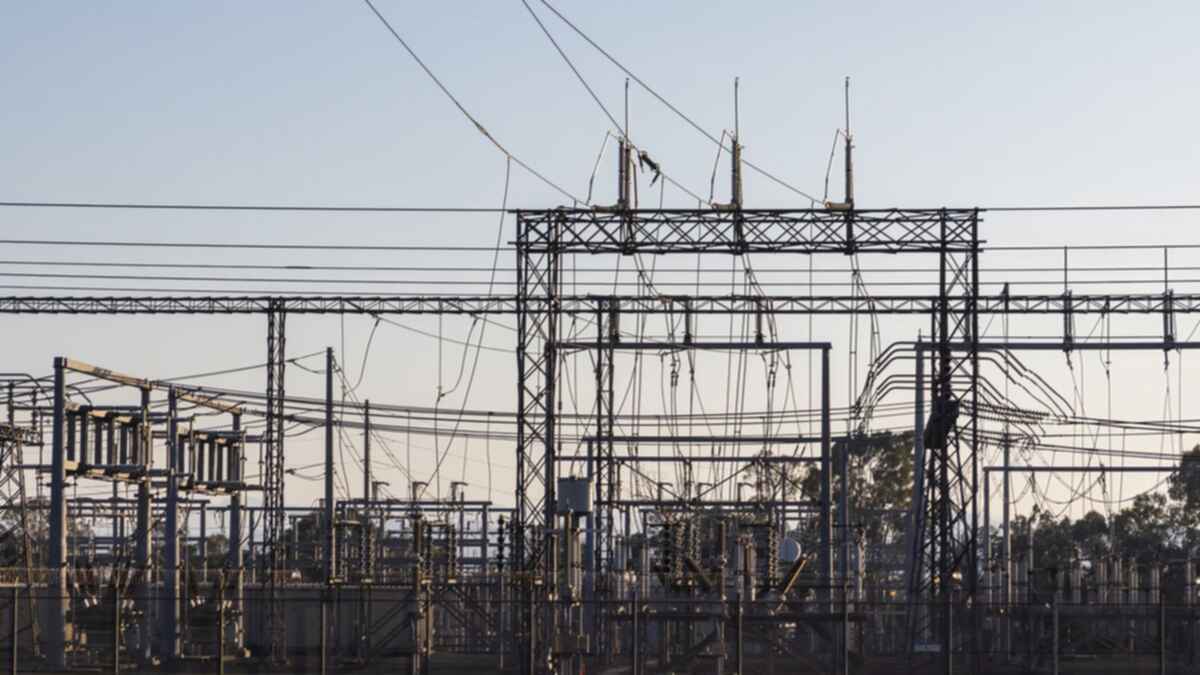
Harmonics are usually only identified by their symptoms: capacitor banks heat up quickly, circuit breakers trip without clear reasons, and transformers hum louder than usual. The source is non-linear loads, such as variable frequency drives (VFD), UPS, battery chargers, and welding machines. These loads draw current in chunks, rather than a complete sine wave. The chopped current also distorts the voltage waveform in the network.
The practical questions are twofold: how much distortion is still acceptable, and where is it measured.
Measured at the point of common coupling, not at each machine
IEEE 519-2022 sets the limit at the point of common coupling (PCC), which is the meeting point between the network owner and the user. For customers supplied through a dedicated transformer, the PCC is usually on the high voltage side of the transformer. If the transformer is shared with other customers, the PCC is generally on the low voltage side. The current limits apply to the entire installation at that point, not just to one VFD.
The Grid Code in Ministerial Regulation ESDM 20/2020 uses the same logic. Business actors, network users, and consumers must keep the harmonic current distortion at the point of coupling below the limits. They are also required to install a power quality meter that continuously monitors and records THD and phase imbalance at the point of coupling (item CC 3.3.3).
Voltage limits: THD
| Voltage at the point of coupling | Grid Code: individual / total | IEEE 519-2022: individual / total |
|---|---|---|
| Up to 1 kV | not regulated | 5.0% / 8.0% |
| 66 kV (IEEE: above 1 to 69 kV) | 3.0% / 5.0% | 3.0% / 5.0% |
| 150 kV (IEEE: above 69 to 161 kV) | 1.5% / 2.5% | 1.5% / 2.5% |
| 500 kV (IEEE: above 161 kV) | 1.0% / 1.5% | 1.0% / 1.5% |
For transmission voltage, the figures are exactly the same. The Grid Code also acknowledges that THD can be exceeded momentarily; PLN then assesses and evaluates the impact on the network and other user equipment.
Current limits: TDD, not THD
The current limit uses TDD (total demand distortion): harmonic current divided by maximum load current (IL), not divided by the fundamental current when measured. According to IEEE 519-2022, IL is calculated from the average peak load over the last twelve months. The difference is noticeable under light loads. An example from a Siemens whitepaper: a measured THDi of 40% at a 50% load is equivalent to a TDD of 20%.
The limit size depends on the short-circuit current ratio at the point of coupling to IL. The stronger the network, the greater the current distortion that is allowed.
| Isc/IL Ratio | Max TDD up to 66 kV (Grid Code) and 120 V to 69 kV (IEEE) | Max TDD above 66 to 150 kV (Grid Code) |
|---|---|---|
| below 20 | 5.0% | 2.5% |
| 20 to below 50 | 8.0% | 4.0% |
| 50 to below 100 | 12.0% | 6.0% |
| 100 to 1,000 | 15.0% | 7.5% |
| above 1,000 | 20.0% | 10.0% |
IEEE's note for this table: generating facilities are limited to the first row (TDD 5%) regardless of the Isc/IL ratio, unless other standards apply. This is relevant for PLTS (solar power plant) inverters connected to the grid.
Three often overlooked points
- Even harmonics are also limited. The 2022 revision imposes the same limits for even and odd orders. For orders 6 and below, even harmonics are limited to 50% of the table figures.
- What is assessed is statistical, not instantaneous values. Since the 2014 revision, the 10-minute voltage value is assessed at the 95th percentile over a week and must be below the table figures. The daily 3-second value is assessed at the 99th percentile and must be below 1.5 times the table. For current, the daily 3-second value must be below 2 times the table. A single measurement with a clamp meter is not sufficient as evidence.
- Capacitors can exacerbate the issue. Power factor correction capacitor banks can resonate with harmonic currents. The relationship with power factor billing has been discussed in the article kVARh penalties and how to calculate them.
If you prefer to see a basic explanation, there is a short clip about why electrical waves are no longer sinusoidal.
Sources
- Kementerian ESDM, Ministerial Regulation ESDM Number 20 of 2020 on the Grid Code, Appendix I items CC 3.3.1, CC 3.3.3, and OC 4.4.
- Kementerian ESDM, Latest Grid Code Regulations Optimize EBT Potential (April 29, 2021).
- IEEE Standards Association, IEEE 519-2022: Standard for Harmonic Control in Electric Power Systems.
- Siemens, Whitepaper: Harmonics in power systems, sections IEEE 519-2022, Tables 1 and 2.
- Mark Halpin, IEEE PES/IAS, IEEE 519-2014, presentation material (2014), percentile-based limits.