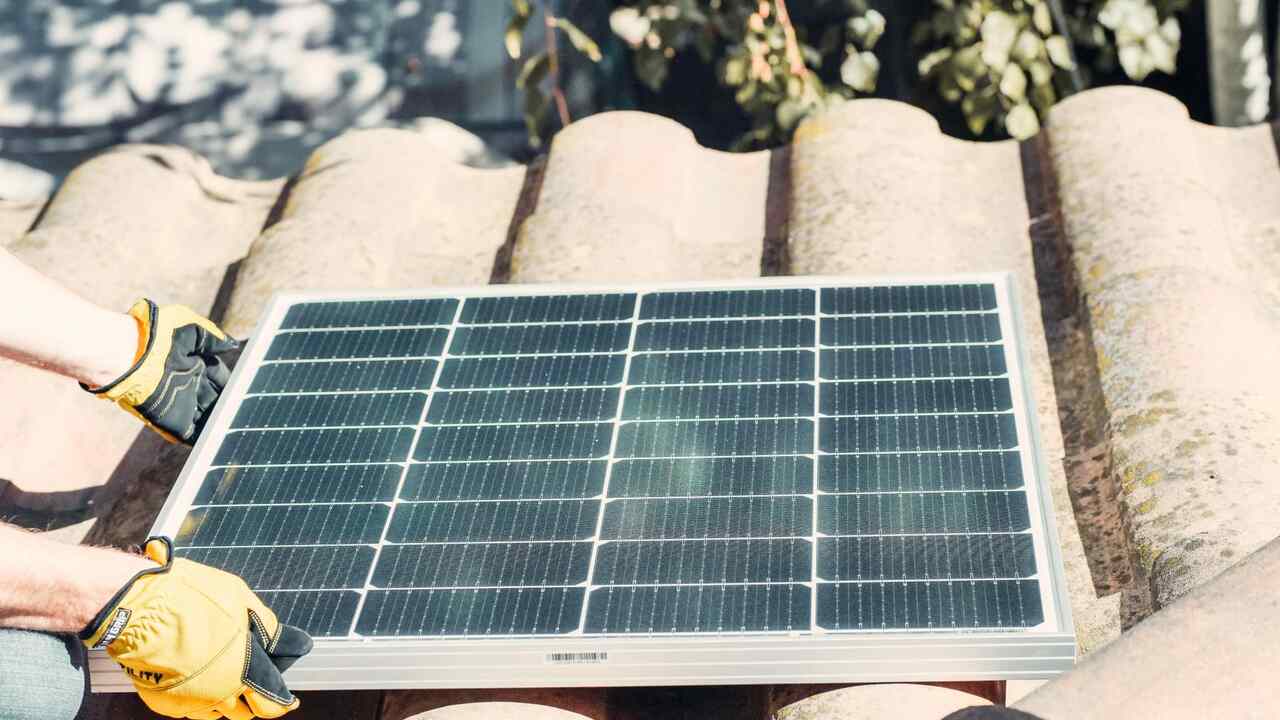
The first question when assessing a roof for solar panels is usually simple: which direction does the roof face, and what is its angle of slope? The answer is often based on standard rules from four-season countries. In Indonesia, which is located near the equator, these rules need to be re-evaluated before being applied.
Two measured angles: azimuth and tilt
Azimuth is the direction the panel faces, measured from true north in a clockwise direction. The general convention, as explained in Penn State materials, is that 0° is north, 90° is east, 180° is south, and 270° is west. Tilt is the angle of the panel relative to a flat surface: 0° means flat, and 90° means vertical.
Both angles affect different aspects. The Sandia PV Performance Modeling Collaborative's modeling guide states that tilt errors affect the amount of irradiance on the panel surface, while azimuth errors change the shape of the irradiance curve throughout the day. This means that a roof facing east or west does not necessarily have to be "failing," but its peak production shifts to the morning or evening.
Standard rule: facing the equator, tilted by latitude
Penn State formulates a practical rule for the northern hemisphere: face the panels true south (180°) with a tilt equal to the latitude of the location. For example, State College, Pennsylvania, at a latitude of about 40°, has an ideal tilt of around 40°. The author notes that this rule is only an approximation: Wilmington, at a nearly identical latitude, is actually ideal at around 35°.
Two things need to be translated for Indonesia. First, our cities are at low latitudes, so the ideal tilt according to this rule is also low. Second, this rule was written for the northern hemisphere. The logic of mirroring, which is to face towards the equator, means that locations south of the equator tend to face north. This is a geometric conclusion from the above rule, not a quote from a specific source.
How significant is the difference?
Penn State illustrates with the tilt and orientation factor (TOF), which is the ratio of output to ideal conditions, for an example at 40° latitude in the northern hemisphere. At an azimuth of 180°, a flat panel (0°) has a value of 0.87, and a vertical panel (90°) has a value of 0.662. At the ideal tilt of 35°, an east-facing panel has a value of 0.797, and a west-facing panel has a value of 0.803. These figures belong to high latitudes, so do not apply them directly to Jakarta or Padang. What can be taken is only the pattern: deviating from the ideal does reduce output, but not by half.
Field evidence near the equator
An experimental study in Padang (around 0°56' S) published in the Rotasi journal of Diponegoro University tested a single 120 Wp monocrystalline panel at tilts of 0°, 15°, 30°, 45°, 60°, and 75°. A tilt of 15° yielded greater daily production, with the best azimuth being around 10.5° towards the northwest, resulting in a daily output of 378.4 Wh. The limitations are clear: one panel, one location, a limited measurement period, and the daily output figures in the paper are not uniform across sections. Use this as an indication that a gentle slope works well at the equator, not as a definitive number for your roof.
Finding the optimum tilt for your location
For specific numbers per location, the Global Solar Atlas provides a layer of data on Optimum Tilt (OPTA), which is the tilt angle that maximizes annual yield worldwide. According to the World Bank catalog, this data was developed by Solargis, with a resolution of about 4 km, and is licensed under Creative Commons Attribution 4.0. Due to its coarse resolution, the results are suitable as a starting point, then compared with the actual roof tilt.
Steps to check your roof
- Measure the direction and tilt of the roof using a compass app on your phone, then record it as azimuth and degrees.
- Find the optimum tilt for your location in the Global Solar Atlas.
- Compare the difference. A sloped roof deviating a few degrees from the optimum is not a major issue.
- Consider when the highest electricity load occurs. Roofs facing east or west shift the peak production, so their suitability depends on usage times, as discussed in the article on daytime load and rooftop solar system sizing.
If you prefer to see how to measure it directly, there is a video explanation.
Sources
- Penn State, EME 810 / EMSC 297, "Tilt and Orientation Factor": https://www.e-education.psu.edu/emsc297/node/681
- Sandia National Laboratories, PV Performance Modeling Collaborative, "Array Orientation Errors": https://pvpmc.sandia.gov/modeling-guide/1-weather-design-inputs/array-orientation/array-orientation-errors/
- World Bank Data Catalog, "World - Optimum Tilt to Maximize Yearly Yield (OPTA)", Global Solar Atlas / Solargis: https://datacatalog.worldbank.org/search/dataset/0038638
- Rotasi Journal, Diponegoro University, study on tilt angle and azimuth of solar panels in Padang: https://ejournal.undip.ac.id/index.php/rotasi/article/download/50987/23580