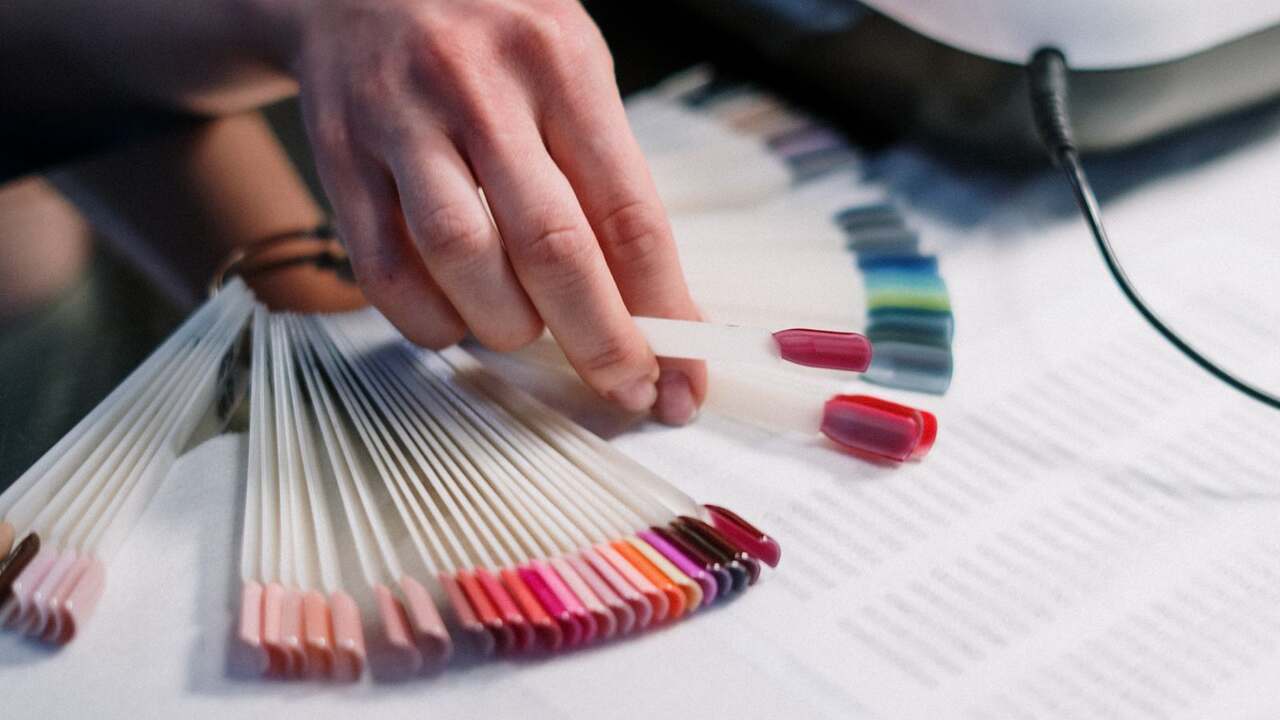
Many people use the terms nail art, manicure, and nail extension as if they mean the same thing. However, they are different, and these differences determine how long the results last, how long the removal process takes, and what risks are associated with your nails.
Four commonly confused terms
- Nail art: the art of decorating the surface of the nails, ranging from painting, arranging colors, to applying stickers, glitter, or ornaments. The decorated can be natural nails or nails that have been previously extended. Nail art refers to the decoration, not the application method.
- Manicure: the care of the nails and surrounding skin. This includes shaping, tidying cuticles, and smoothing the surface. A manicure can stand alone without any decoration.
- Fake nails or press-on: ready-to-use fake nails that are applied. This method is the quickest to apply, can be removed by yourself, and looks the least natural among the three.
- Nail extension: nails are extended with materials formed directly on top of the natural nails, typically using gel or acrylic. This method is the most durable, but also takes the longest to remove.
The terms for the person performing these tasks are also often questioned. Nailist, nail artist, and nail technician refer to the person doing the work, not the technique. In Indonesia, "nailist" is most commonly used in salons, while "nail technician" appears more frequently in literature and foreign certification schemes.
Why some need a lamp and others do not
- Conventional nail polish dries as the solvent evaporates. It does not require a lamp.
- Gel polish does not dry; instead, it hardens through a chemical reaction triggered by light. Therefore, it requires a UV or LED lamp.
- Acrylic hardens from the reaction between polymer powder and monomer liquid, without a lamp, and has a sharp odor.
This difference explains why gel polish and acrylic cannot be removed in seconds like regular nail polish.
What can go wrong with nails
A literature review from the Department of Dermatology, Venereology, and Aesthetics at the Faculty of Medicine, University of Indonesia, published in Media Dermato-Venereologica Indonesiana in June 2026, notes abnormalities that can arise from the use of nail polish and nail art: brittle nails, onycholysis (separation of the nail from its bed), contact dermatitis, infections, discoloration of the nails, and concerns regarding the long-term risks of ultraviolet exposure from gel use. Highlighted materials include formaldehyde, acrylates, methacrylates, and organic solvents.
There are also issues purely related to time. Press-on nails or extensions left on for weeks will leave gaps as the natural nails grow. These gaps can trap water and become breeding grounds for fungi.
The products are cosmetics, not over-the-counter items
Nail polish, gel, and extension materials fall under the category of cosmetics. The technical requirements for these materials are now regulated by BPOM Regulation Number 25 of 2025 concerning Technical Requirements for Cosmetic Materials, effective from October 3, 2025, replacing BPOM Regulation Number 23 of 2019 and its amendments Number 17 of 2022. The document is 352 pages long, with 344 of those pages being appendices listing materials.
What you can do without reading all 352 pages: ask to see the product packaging used, then check the notification number in the BPOM Check service. Products without a notification number mean they have not passed the safety assessment of the materials.
One more thing that customers rarely ask about: tools. Files, cuticle scissors, and electric drills are used from one person to another. Sterilization of tools is just as crucial as the choice of materials.
If you are more interested in the expressive side rather than the technical aspects, there is a separate discussion about nail art as a form of self-expression.
Sources
- Liana MR, Wibawa LP, Astriningrum R, Budianti WK, Yusharyahya SN. "Nail Abnormalities Due to the Use of Nail Polish and Nail Art", Media Dermato-Venereologica Indonesiana Vol. 53 No. 2 (2026), Perdoski. https://ojs.perdoski.id/index.php/mdvi/article/view/608
- BPOM Regulation Number 25 of 2025 concerning Technical Requirements for Cosmetic Materials, JDIH BPK RI. https://peraturan.bpk.go.id/Details/333277/peraturan-bpom-no-25-tahun-2025
- BPOM Product Check Service, Food and Drug Supervisory Agency. https://cekbpom.pom.go.id/
- "Want to Apply Nail Art? Understand the Difference Between Fake Nails and Nail Extensions", Kompas.com, October 5, 2023. https://lifestyle.kompas.com/read/2023/10/05/090000120/ingin-pasang-nail-art-pahami-beda-fake-nails-dan-nail-extension-