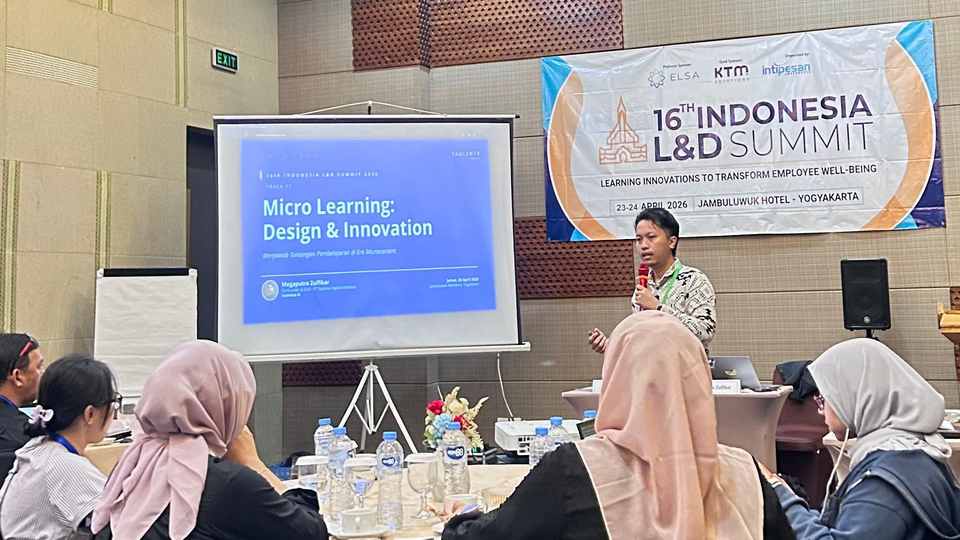
On April 23 and 24, 2026, dozens of Learning & Development practitioners from various industries in Indonesia gathered at Jambuluwuk Malioboro Hotel, Yogyakarta. The event was the 16th Indonesia Learning & Development Summit, an annual event by Intipesan now entering its sixteenth edition. This year's theme feels contextual with the post-pandemic shift in work methods: “Learning Innovations to Transform Employee Well-Being.”
One of the parallel sessions on the second day of the summit was hosted by Taalenta. Track 11: Micro Learning – Design & Innovation was presented by Megaputra Zulfikar Whana Aji Kesdu, commonly known as Ega Zulfikar, the Operational Director of PT Taalenta Digital Inteleksia. The session took place on Friday, April 24, 2026, from 10:15 to 11:30 WIB, and was attended by dozens of participants from HR Directors, L&D Managers, to HR development consultants. Ega intentionally positioned himself not as a product promoter, but as an observer and thinker in L&D who wanted to share patterns he found repeatedly in many organizations.
Debunking Two Major Myths of Micro Learning
The session opened with two simple questions. “Who here has a company LMS?” Several participants raised their hands. “Now, who has employees that actually use that LMS when they need quick answers in the field?” The responses were more cautious. The same pattern, Ega noted, is often found across various industries: infrastructure investment is in place, but adoption in the field lags far behind.
From this observation, he debunked two myths. First, micro learning is not just about cutting a two-hour video into ten five-minute segments. That’s just a short video. True micro learning is a small solution package that addresses one specific problem in the field, accessible right when needed. Second, micro learning is not a daily obligation imposed on employees. The trend of “one micro learning per day” sounds good, but it still follows a Just-In-Case approach, sharing the same philosophy as conventional training, just in a different format. The true power of micro learning, he emphasized, lies in Just-In-Time, which is the answer that appears right when the problem occurs.
Librarian Node: Innovation Not in Technology
The largest part of the session was filled with a concept that Ega named “Librarian Node.” The premise is clear: most company LMSs are libraries without librarians. The books are there, but no one helps employees find the answers they need right then and there. The solution, he argued, is not to add platforms or buy new AI, but to acknowledge a role that usually exists organically in every division: the person who is most often asked when there is a problem.
“Think for a moment. In your division, who is the person that everyone asks first when there’s a problem? It might not be the manager, it might not be HR, but they know the answer. That’s your first candidate for the Librarian Node.”
The role of L&D in this ecosystem, he added, actually elevates. “You are not the librarian. You are the architect of the library.” L&D designs the standard quality framework, trains the Librarian Nodes, provides tools and distribution channels, and then measures the impact. Without L&D, the system may still run, but it will be chaotic and without measurable standards.
Empowered Employees as a Form of Employee Well-Being
Closing the session, Ega drew a connection to the summit's theme. The ultimate goal of micro learning, he said, is not just training efficiency, but to create empowered employees: those who can solve problems on their own without always waiting for their superiors or technical teams. Independent employees, he argued, are more confident, and that is one of the most concrete forms of well-being in the workplace.
He also encouraged the audience to change their measurement approach. “Stop measuring how many hours employees sit in class. Start measuring how many problems employees can solve after accessing micro learning.” The new metrics he recommended include problem resolution time, the number of escalations reduced, and the level of self-service.
Notes from Yogyakarta
The second day of the summit also featured a plenary session on re-skilling and up-skilling presented by Dr. Yunus Triyonggo from Bridgestone, as well as a closing plenary discussing humor in training by Mi’ing alongside Dr. Sumaryono from Universitas Gadjah Mada. The parallel tracks in the same slot as Track 11 covered Leadership Development Programs, Gamification, and Measuring Impact & ROI. The composition of sessions reflects the breadth of conversation currently developing in the L&D community in Indonesia.
For the L&D sector in the country, this summit reinforces a message that is actually simple: how organizations prepare their employees determines how quickly they can adapt. And true adaptation, as Ega reminded at the end of his session, starts with small steps: “Tomorrow Monday, meet the person in your team who is most often asked about work. Invite them to chat for fifteen minutes. That’s your first step.”
References:
- Intipesan – 16th Indonesia Learning & Development Summit 2026 → ildsummit.com
- Murre, J. M. & Dros, J. (2015) – Replication and Analysis of Ebbinghaus’ Forgetting Curve, PLOS ONE 10(7) → journals.plos.org
- LinkedIn Learning – Workplace Learning Report 2024 → learning.linkedin.com
- Training Industry – Training Industry Report 2025 → trainingindustry.com