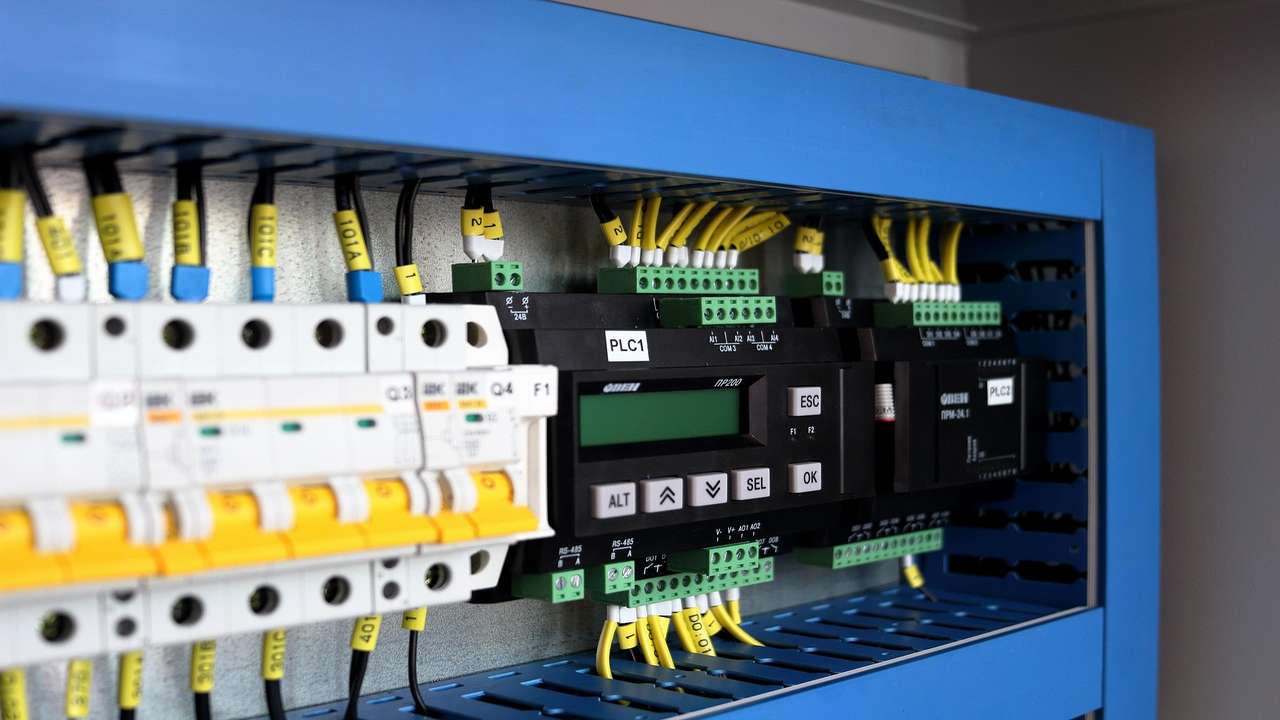
Many factories in Indonesia have had PLCs for over a decade. Machines are running, production lines are moving, outputs are being produced. But when asked about the real-time performance of line A this morning, the operator's answer is often the same: wait, let me check on the floor first.
This is where the gap between machines and management starts to become apparent. The PLC has been controlling the process well, but the data stops at the panel rack. In fact, Industry 4.0 is not just about advanced robots or AI on the assembly line. It’s about data: complete, real-time data that can be accessed by anyone who needs it, from supervisors to executives.
Modern Factories, Still Murky Visibility
A survey by the Ministry of Industry shows that the utilization of national manufacturing capacity remains around 70 to 75 percent throughout 2024 to early 2025. One of the contributors to this gap is not a lack of orders, but untracked downtime and slow decision-making due to data being locked on the shop floor. This is a typical condition in Indonesia: PLCs of any brand are operational, motor controls, valves, and sensors are automated. But when management wants to know today’s OEE (Overall Equipment Effectiveness), the answer requires a physical visit to the production floor or waiting for a manual recap at the end of the shift. What should take ten seconds ends up taking half an hour. This gap is not about the competence of PLC engineers. They are usually skilled on the control side. What often gets neglected is the layer above, which is the system that elevates PLC data to a broader visibility level.
SCADA Is Not Just a Colorful Screen
SCADA, which stands for Supervisory Control and Data Acquisition, is often misunderstood as a large screen in the control room. In reality, SCADA is a complete architecture that collects data from multiple PLCs, stores it in database tags, displays it in trending graphs, and serves alarm and logging functions. In a factory with a properly built SCADA, line supervisors can see the status of all machines on one screen. Plant managers can pull trending data on reactor temperatures from last week. Maintenance can read alarm history for root cause analysis. Executives can request daily OEE reports without having to wait for a manual recap. What makes SCADA not automatically present is the need for integration. PLCs from various brands and generations must be able to communicate with one SCADA system. This is often the work that gets overlooked in standard PLC training descriptions.
Modbus: The Underrated Backbone
The question then arises, how does SCADA get data from PLCs? This is often answered in passing. The answer is one word: communication protocol, and the most common in Indonesian industry is Modbus. Modbus, with its RTU version on RS-485 and TCP/IP on Ethernet, has been around since the late 1970s and remains the de facto standard. Schneider Electric, Mitsubishi, Omron, and even local PLCs support Modbus. The International Society of Automation includes it as a fundamental protocol in the ISA-95 and ISA-101 standards. Engineers who understand Modbus can connect any PLC to HMI or SCADA, without being tied to a proprietary ecosystem. What needs to be understood is not just how to set slave addresses, but also the concepts of tag mapping, register addressing, and polling strategies to avoid overloading the network. Ironically, many PLC trainings in Indonesia stop at ladder program practices. The Modbus and SCADA integration sections are rarely included in the basic package. As a result, graduates can program PLCs, but when asked to display this data on a management dashboard, they revert to the vendor or subcontractor.
The Burden of Automation Engineers in Indonesia in the Era of Smart Manufacturing
The Making Indonesia 4.0 roadmap released by the government since 2018 encourages the widespread adoption of industrial automation technology. Five priority sectors (food and beverage, automotive, textiles, electronics, chemicals) are targeted to adopt smart manufacturing. However, in practice, the biggest obstacle is not the investment in advanced machines, but the competence of automation engineers who are ready to integrate existing systems. The demand for multi-skilled automation engineers, who can not only handle PLCs but also HMI, SCADA, and at least industrial communication protocols, continues to rise alongside the push for factory modernization. Engineers who can do wiring while also understanding how data flows to SCADA become the sought-after profile by system integrators and factories looking to modernize without a rip-and-replace approach. On the career side, this gap creates a significant differentiation. Technicians who upgrade to multi-skilled automation engineer levels usually experience significant changes in terms of responsibility, position, and of course, compensation.
Conclusion
In the short term, Indonesian factories may still operate with the old scheme: PLC control, operators record, management waits. But as more competition arises from factories that already use SCADA and real-time dashboards, sticking to the old model is starting to feel costly. The question is no longer whether it is necessary, but who will integrate it.
References:
- Ministry of Industry of the Republic of Indonesia – Statistics & Manufacturing Outlook 2024 → kemenperin.go.id
- Ministry of Industry of the Republic of Indonesia – Making Indonesia 4.0 Roadmap → kemenperin.go.id
- International Society of Automation – ISA-95 Standard for Enterprise-Control System Integration → isa.org
- Modbus Organization – Modbus Application Protocol Specification V1.1b3 → modbus.org
- Schneider Electric – EcoStruxure for Industry: Open Architecture for Smart Manufacturing → se.com