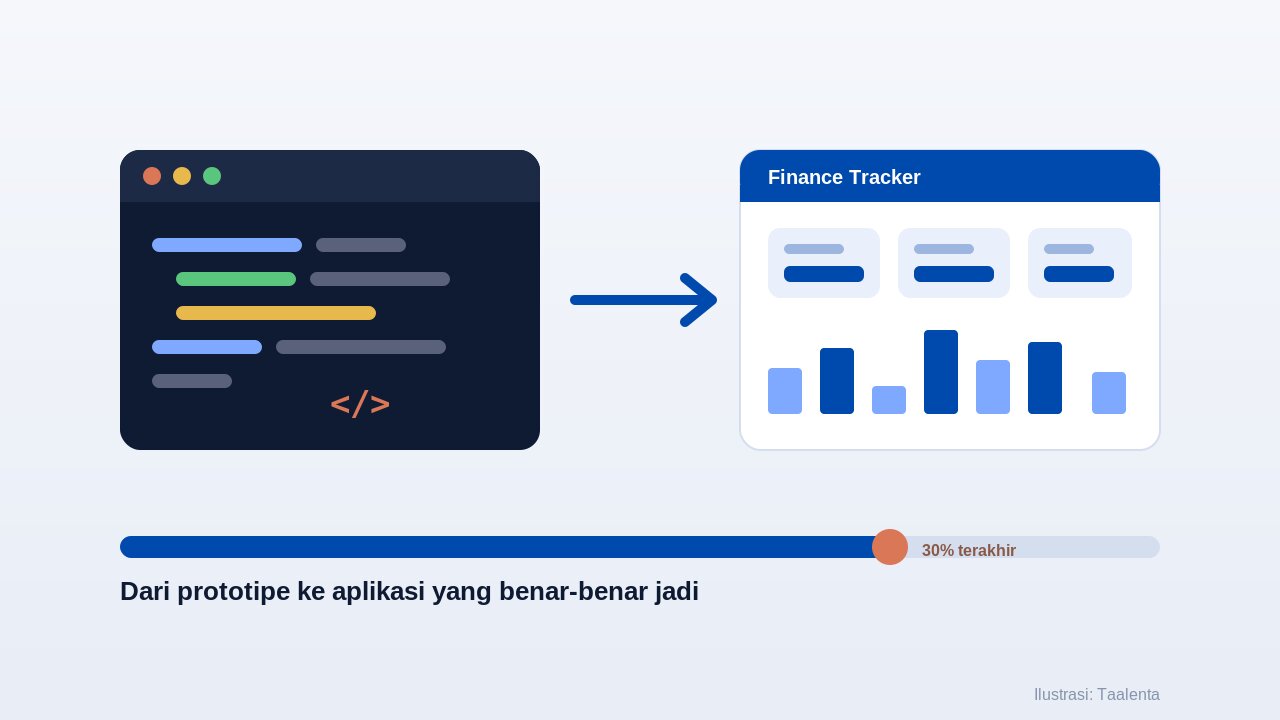
Creating application interfaces can now be done in just minutes. You simply explain what you want, and AI writes the code for you. The results appear on the screen, looking neat, and it feels like magic. However, there is a significant gap between the demo running in your browser and an application that can actually be used by others.
This gap has a name. Addy Osmani, an engineer on the Google Chrome team, refers to it as the "70 percent problem." AI quickly brings you to about 70 percent of the solution, then the remaining 30 percent turns into a struggle. Each fix seems to introduce new bugs, and you get stuck in a cycle of fixing one thing while breaking another. For some projects, the figure even shifts to 80 percent, but the essence remains the same: the initial part feels easy, the final part is what matters.
What Does the Last 30 Percent Entail?
The remaining part is not about typing more code. It involves things that are not visible in a demo: connecting to a real database so that data is actually stored, not just examples; building a proper login system and access rights; patching cascading bugs; checking security; and finally deploying the application so it can be accessed via an address, not just running on your localhost.
This is where non-developers often give up. Not because they are incapable, but because they do not know what is actually broken, what is not secure, and what is not connected. Without a map, the once neat pile of code turns into a mystery.
Why Workflow is More Important than Just Chatting with AI
The key to completing the last 30 percent is not smarter prompts, but discipline. Instead of asking AI to build the entire application at once, practitioners break the work down: transforming ideas into a brief requirements document or PRD, dividing it into small features, building one feature at a time, and then testing it in the browser before moving on. They read every change written by AI, rather than accepting it blindly, and keep a safe point to return to if something breaks.
This simple pattern is what distinguishes projects that are truly completed from those that stall halfway.
Two Agents, Different Strengths
The tools for this work are also well-developed. OpenAI's Codex CLI, a coding agent that runs in the terminal, was released in April 2025 and is now used by around four million people every week. Claude Code from Anthropic is known for its ability to reason through entire projects and make cross-file decisions. Both can complement each other: one excels at driving the terminal and writing code quickly, while the other keeps the big picture sensible. Coupled with tools like Context7 to help trace bugs, a non-developer does not need to memorize the contents, just know how to direct it.
The Goal is Not to Become a Programmer
The point of all this is not to turn you into a software engineer. The goal is more down-to-earth: to get one application that truly works for your own needs, whether it's a financial tracker, an internal work tool, or a product prototype, without having to wait in line for a developer team. Its greatest value lies not in the first 70 percent that is easy, but in the ability to complete the last 30 percent until the application is truly usable.
Taalenta offers a practical class "Create Your Own Website and Application Without Coding with Claude Code and Codex," where you will build a complete application from planning to deployment in two sessions, with a final result that truly works.